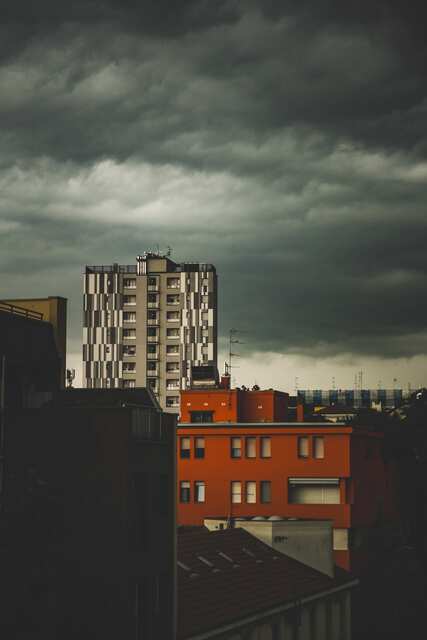
Cape Breton took more than 200 millimetres of rain over a single weekend this September, and a section of road near Marble Mountain washed out under the water. If you run a business anywhere in Nova Scotia, that kind of storm raises a fair question: does your commercial policy actually pay when water gets into your building from outside, not from a burst pipe? For most standard commercial property policies, the answer is no. Flood damage insurance in Nova Scotia usually has to be added on purpose. It is not part of the base policy.

What Happened in Cape Breton This September
On September 5 and 6, heavy rain settled over Cape Breton Island and did not let up. Richmond County saw more than 200 millimetres of rain, Ingonish Beach recorded about 130 millimetres, and Sydney logged roughly 105 millimetres, according to Global News. Inverness, Victoria and Richmond counties all declared a state of emergency, and a stretch of road near Marble Mountain gave way completely, according to CTV News. A woman from Cleveland, Nova Scotia died after her vehicle was found parked near a flooded bridge. Premier Tim Houston called the damage extensive and said the full scope would not be known until the storm passed.
None of that happened in Halifax. But the same kind of system that sat over Cape Breton this month can sit over HRM next, and the insurance question underneath it does not change by postal code.
What Does Flood Damage Insurance Actually Cover?
Commercial property insurance protects your building, equipment and stock against a list of perils. Some policies name specific perils, others are written as all risk, meaning everything is covered except what the wording specifically excludes, according to the Insurance Bureau of Canada. Fire is almost always covered. Water that rises from outside your building, a river overflowing, a storm surge, or rain that pools faster than the ground can absorb it, usually is not.
What Is Overland Flood Coverage?
Overland flood coverage is the add-on that closes that gap. It responds to water that comes from outside your property line, whether that is an overflowing river, surface water after heavy rain, or melting snow. It is different from sewer backup coverage, which responds when water backs up through your own drains, and different again from the coverage that answers a pipe bursting inside your walls. A business can carry two of the three and never notice the third was left off.
Worth flagging plainly: the federal government’s own consumer page on overland flood insurance speaks only to homeowners, renters and landlords. It does not mention business owners at all. That gap in the public guidance is not an accident of one webpage. Flood coverage for a business gets arranged individually, through a broker who asks the insurer directly, not through a form everyone assumes already applies to them.

Nova Scotia Carries More Flood Risk Than Most of the Country
Nova Scotia has the highest number of properties at risk from flooding of any province in Atlantic Canada, according to the province’s own climate change page. The July 2023 floods alone caused roughly 243 million dollars in insured damage. None of that is meant to be alarming on its own. It explains why a broker working here treats flood coverage as a question to ask on every commercial file, not a line item to mention once and move past.
What Happens If You Are Not Covered
Nova Scotia runs a Disaster Financial Assistance Program for losses insurance will not pay, and it covers small businesses along with homeowners and non-profits. To qualify, you need a Confirmation of Insurance form from your own insurer showing the loss was not covered, and the program pays up to 200,000 dollars toward what is left.
Does the Program Replace My Insurance?
No, and the province says so directly. Disaster financial assistance is built to help a business move forward after an uninsured loss, not to replace the coverage itself, and it only ever pays for what your policy did not. If your commercial property already carries a flood endorsement, this program never enters the conversation, because there is no uninsured gap left for it to fill.
Who Carries the Most Exposure Here
A restaurant near the waterfront or a low stretch of the Bedford Highway is looking at structural damage and a walk-in cooler full of stock if water gets in. A contractor with a job site near a culvert or low ground is looking at materials and tools sitting exposed, the same exposure builder’s risk insurance, the policy that covers a project while it is still under construction, already has to account for. A commercial property owner carrying tenants is looking at the building itself plus whatever the lease says about who covers what. None of these are new categories of risk. They are the same categories, tested by a peril a lot of standard policies were never written to answer.

What to Actually Do This Week
- Pull your current commercial policy and look specifically for the words overland flood or flood endorsement, not just water damage or property coverage.
- Ask your broker to confirm whether sewer backup and overland flood are two separate lines on your policy, or missing entirely.
- If your building sits near a river, the harbour, or low ground that pools after heavy rain, ask what your insurer’s own flood risk assessment says about your address.
- Photograph your building’s ground floor and anything stored low, so you have a clear before if a claim ever needs one.
- If a loss happens and your policy does not respond, ask your insurer for a Confirmation of Insurance form before assuming disaster assistance is not worth applying for.
I’m Rayanur Rahman, a commercial insurance broker in Bedford. If you already have a commercial policy and are not sure whether flood is actually named in it, send it to me and I will read it and tell you plainly what it covers, no cost to look, before the next storm tests it for you.
Ask the Question Before the Next Storm Does
None of this means every business near water is one storm away from a loss. It means the standard policy behind most Halifax businesses was built to answer fire and wind, not a river that rises faster than the ground can take it. Cape Breton found that out the hard way this month. Ask the question about your own wording before the next system parks itself over Nova Scotia and decides it for you.
Not Sure If Flood Damage Is Covered?
Send me your current policy and I’ll tell you plainly whether overland water or flood damage is actually named in it, no cost to look.
About the author. Rayanur Rahman is a commercial insurance broker with Western Financial Group in Bedford, Nova Scotia. He places commercial policies for restaurants, contractors, trucking and transportation companies and commercial property owners across the Halifax Regional Municipality, with access to the standard Canadian insurers and to specialty and MGA markets. He remarkets a client’s policy at renewal instead of letting it roll over on the same terms year after year, so a gap like a missing flood endorsement gets caught before the next storm, not after. Reach him at 902-321-1712 or book a 30 minute call.
Sources: Global News. CTV News. Government of Nova Scotia: Flooding. Government of Nova Scotia: Disaster Financial Assistance Program. Insurance Bureau of Canada: Types of Business Insurance Coverage. Photo by Francesco Ungaro on Pexels. Photo by Oscar Sánchez on Pexels. Photo by Atahan Demir on Pexels. General information only, not advice on your specific policy. Check your own wording.
Leave a Reply